Pip Educational Robot
Complete hardware development of an affordable educational robot for K-8 classrooms

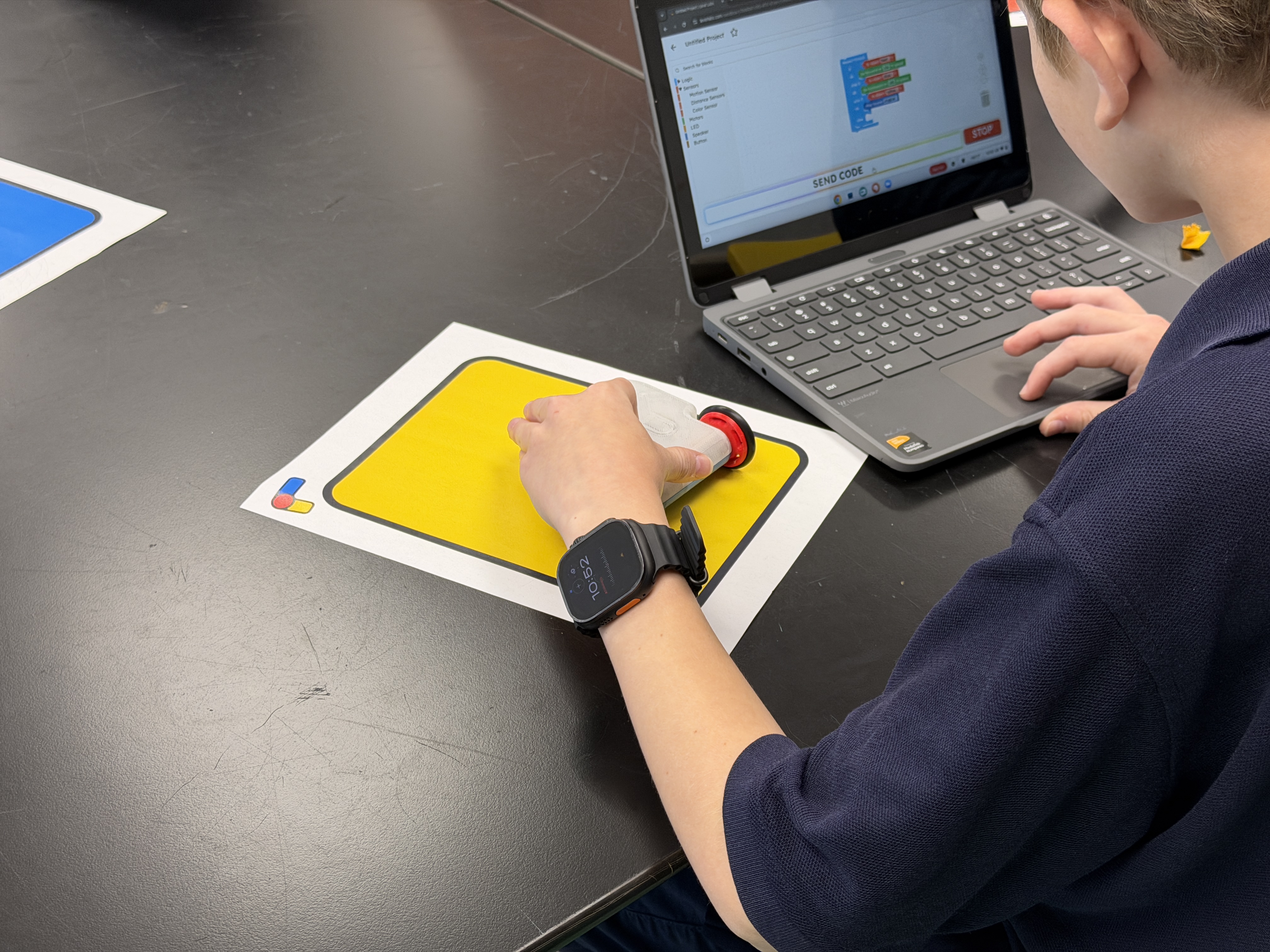
Pip is an educational robot designed to make robotics and programming accessible to K-8 classrooms. Conceived as a superior alternative to existing educational robotics tools, Pip combines sensors, motors, and wireless connectivity in a kid-friendly platform. Students learn through a gamified, Duolingo-style web interface where hardware and software work together to teach coding fundamentals through hands-on interaction.
Project Overview
System:
- ESP32-S3 microcontroller with WiFi/BLE
- Multi-sensor suite: IMU, ToF distance sensors, color sensor
- User interface: OLED display, buttons, LEDs, buzzer
- Dual DC motors with quadrature encoders
- Web-based programming platform
Hardware:
- 5-board modular architecture: 4-layer rigid main board + 3 custom 2-layer flex peripheral boards
- PETG enclosure designed for classroom durability (90mm × 90mm × 39mm, 170g)
- Complete mechanical-electrical integration: custom TPU wheels, heat-set assembly, Hirose backplane connectors
Key Results:
- Multiple hardware revisions driving ~70% cost reduction through component optimization and DFM improvements
- Assembly time reduced from 45 minutes to 4 minutes via connector integration (eliminated all manual soldering)
- Production-ready design validated through 30+ student classroom pilot with 200+ hours of real-world use
Hardware Design
Pip's mechanical design focused on durability, compact integration, and manufacturability. The two-part enclosure houses motors, battery, multi-board PCB system, and sensor suite in a 90mm × 90mm × 39mm package (170g total weight) designed to survive repeated drops and rough handling by elementary and middle school students.

Enclosure Design


Material Selection
Enclosure: PETG was selected for high impact resistance and 3D printing stability—superior to PLA for drop protection while remaining cost-effective. Shell corners were reinforced with fillets to distribute impact forces and reduce stress concentrations. Constant wall thickness optimizes current 3D printing production while enabling future injection molding with materials like ABS.
Assembly & DFM
The enclosure is held together with heat-set threaded inserts and M3 screws, chosen to enable repeated assembly and disassembly during testing—welding would permanently seal the enclosure, while self-tapping screws lose holding strength with repeated use and are particularly weak with 3D-printed layer lines. The design is ready to transition to snap-fit assembly for future injection-molded production.
Battery retention uses friction fit with foam mounting tape to dampen vibrations and impact. The front sensor board mount doubles as a main PCB standoff to reduce part count. Motor mounts are integral to the two shell halves—motors are retained simply by the two halves being screwed together, eliminating separate mounting hardware.
Shell Components


The final shell design was achieved through rapid iteration of 30+ prototypes, each testing different feature configurations, mounting geometries, and structural reinforcements.

Integration
The mechanical design required tight integration of:
- Dual 6V N20 geared DC motors with custom flex PCB encoder boards
- 1800mAh LiPo battery pack (3.7V)
- Multi-board PCB system with precise alignment for Hirose backplane connectors
- Front sensor assembly mounted at 40° angle for proper time-of-flight sensor field of view through enclosure
- Wire routing paths that don't interfere with assembly or create stress points

Wheels
Custom TPU wheels (39mm diameter, soft durometer) provide vibration damping and protect internal components during drops. Buna-N rubber O-rings (5mm cross-section, 70A durometer) serve as tires for superior traction compared to bare 3D-printed TPU.

Testing & Validation
Drop Testing: Validated survival from 1m drops onto hard surfaces (typical desk height for target age group). Several dozen controlled drops during development phase.
Durability Testing: Automated drive tests to validate motors, wheel retention, and structural integrity under sustained vibration.
Classroom Deployment: 30+ students, 200+ hours of real-world use. Zero hardware failures. Design successfully handled being dropped, thrown, run into walls, and general abuse from K-8 students.
Key Results:
- Zero structural failures through pilot program
- Design validated for production durability requirements
- Confirmed readiness for transition to injection molding at scale
Electronics Design
Multi-Board Architecture
Pip’s hardware is built on a 5-board system: one 4-layer rigid main board serving as the central hub, with three 2-layer flex peripheral boards handling sensors and motor encoders. This modular approach enabled independent design iteration, simplified assembly, and optimized board real estate for component placement.

Main Board (4-Layer Rigid PCB)
Central processing and power management hub containing:
- ESP32-S3-WROOM-1 module (WiFi/BLE)
- Complete TI power management architecture: LiPo charging, system regulation, motor boost conversion, voltage divider battery monitoring with MOSFET for power savings
- DRV8411 dual motor driver
- LSM6DSV16X 6-axis IMU
- OLED display, user interface (buttons, LEDs, buzzer)
- USB-C interface with ESD protection
- Hirose backplane connectors (peripheral boards), Molex connector (display), JST connector (battery)
- I2C bus routing to sensor suite


Front Sensor Board
Obstacle detection and navigation
- VL53L1CX multizone ToF distance sensor (forward-looking)
- Dual VCNL36828P side-looking 1D ToF sensors
- Dual RGB LEDs (headlights)
- 2-layer flex design: conforms to curved mounting surface for proper sensor angle through enclosure, integral flex cable to main board backplane connector


Bottom Sensor Board
Line-following and surface detection
- VEML3328 color sensor
- 3014 LED (illumination)
- 2-layer flex with double-sided assembly, integral cable and backplane connector
- Heat-staked directly to enclosure


Encoder Boards
Motor position feedback
- TLE4946-2K hall effect sensors
- Shaft-mounted magnets
- 2-layer flex with stiffener for durability
- Soldered directly to motor pins, backplane connector to main board
- Mirrored left/right layouts


Design Evolution
Proof of Concept
- Core system validation: ESP32-S3 wireless control, motor driver (DRV8411), LiPo charging (BQ25185), voltage regulation (TLV62085)
- USB-C interface

Rev 1
- Production form factor and shape established
- User buttons, RGB LEDs
- Speaker (8Ω) with PAM8302AAS driver
- BNO085 9-axis IMU
- Increased bulk capacitance to motor driver (resolved ESP stability issues from proof of concept)
- Solder pad connections for peripheral boards (motors, front board, bottom board)

Rev 2
- Upgraded power electronics: BQ24075 charger + BQ27441 battery monitor IC
- Increased motor voltage: Added TPS61088 boost converter for motor power (6V instead of 3.3V for higher speed and torque)
- Audio improvement: MAX98357A speaker driver (enabled volume control)
- Speaker upgrade: wired → SMD
- Added OLED display support (solder pads and supporting electronics)

Rev 3
- I2C redesign: Split to dual I2C channels, added TCA9617B I2C buffer, improved routing to eliminate long branches and stubs (resolved bandwidth/stability issues)
- Motor power stability: Added current limiting resistor to motor driver (resolved ESP32 brownout during rapid direction changes)
- Power management: Added TPS22810 load switch to cut idle power while maintaining ESP32 low-power mode (off-state battery life: days → months)

Rev 4
- Motor encoder integration: Redesigned motor solder pads for custom flex PCB encoder boards (smaller footprint, eliminated large hand-solder pads)
- I2C optimization: Moved IMU to secondary I2C line with battery monitor (further stability improvements)
- General routing improvements

Rev 5 (Final Production)
- Cost optimization: Battery monitor to voltage divider, 9-axis to 6-axis IMU (LSM6DSV16X), speaker+driver to buzzer, N16R8 to N4 ESP32 (PSRAM removal)
- I2C simplification: Single bus (battery monitor removal eliminated bandwidth issues)
- Connectors & DFM: Hirose backplane (peripheral boards), Molex (display), JST (battery) - eliminated all soldering (assembly: 45 min to 4 min)
- Protection & layout: TPD4E05U06 USB ESD, optimized routing and component placement, relocated USB-C/LEDs

Peripheral Board Evolution
Front Sensor Board
Rev 1: VL53L7CX multizone ToF, dual RGB LEDs, VCNL36828P side ToFs with voltage regulators, constrained outline limited routing, no alignment features caused installation issues
Rev 2: Expanded outline for improved routing, added alignment features, switched to VL53L5CX (cost reduction)
Rev 3 (Final): VL53L5CX → VL53L1CX (cost reduction), added Hirose backplane connector (DFM), improved routing

Bottom Sensor Board
Rev 1: 4-layer rigid PCB with custom flex cable, 5x VCNT2020 IR sensor array (TMUX1208 analog multiplexer, CSD17484F4 power control), VEML3328 color sensor with 3014 LED (CSD17484F4 power control), small MOSFET package caused assembly failures
Rev 2: CSD17484F4 to NTK3134NT1G (larger footprint resolved assembly issues), improved flex cable outline for better routing
Rev 3 (Final): Eliminated IR sensor array (color sensor sufficient for line-following, cost reduction), 4-layer rigid to 2-layer flex PCB with integral flex ribbon and Hirose connector (eliminated soldering, reduced size)

Encoder Boards
Rev 1: 2-layer flex PCB with integral flex cable, dual TLE4946-2K hall effect sensors, soldered to motor pins and main board solder pads, mirrored left/right layouts
Rev 2 (Final): Improved routing, added Hirose backplane connector (eliminated main board soldering)

Production Assembly


Web Platform
Quest
Duolingo-style gamified curriculum where students learn through real-time interaction between Pip’s physical actions and web-based challenges

Sandbox
Unrestricted coding playground for creating and uploading custom programs to Pip

Garage
Free play mode to drive Pip around, customize colors, sounds, and display

Classroom Deployment